How AI and Patent Risk Are Changing the Future of Solar and the Smart Grid
The transition to clean energy is often described in physical terms: more solar panels, larger battery systems, expanded transmission networks, and new renewable-energy projects.
But behind this visible infrastructure is another transformation that may prove equally important. The electric grid is becoming digital.
Modern energy systems increasingly depend on sophisticated software, artificial intelligence, real-time communications, smart meters, automated controls, and advanced forecasting systems. These technologies help manage everything from rooftop solar and utility-scale renewable generation to battery energy storage and modern solar solutions.
As this digital transformation accelerates, a new strategic challenge is emerging: intellectual-property risk.
Why the Modern Electric Grid Is More Complex
Historically, electricity generally moved in one direction. Large power plants generated energy, which traveled through transmission and distribution networks before reaching customers.
Solar and energy storage have fundamentally changed that model.
Homes and businesses can now generate their own electricity. Batteries can store energy and return it to the grid later. Large solar facilities must respond to weather conditions, grid requirements, market signals, and rapidly changing electricity demand.
For organizations exploring commercial solar and clean energy solutions, this transformation creates tremendous opportunities—but it also requires increasingly sophisticated technology.
The Software Behind Solar Is Becoming More Valuable
A solar panel may appear simple from the outside, but modern renewable-energy systems depend on a complex digital infrastructure.
Software can forecast solar generation, detect equipment problems, manage battery charging and discharging, respond to electricity prices, and coordinate thousands of distributed energy resources.
Artificial intelligence is making these capabilities even more advanced.
Machine-learning systems can analyze enormous amounts of data faster than human operators, helping energy companies anticipate changes in production and demand. As renewable penetration increases, these capabilities could become increasingly important to maintaining grid reliability.
Where Patent Risk Enters the Picture
Many technologies supporting the smart grid have been under development for decades. Companies have secured patents involving smart meters, communications protocols, energy management systems, automated controls, and other digital technologies.
Now, a new generation of patents involving artificial intelligence and machine learning is being layered onto that existing technology landscape.
This can create complex questions for utilities, solar developers, battery companies, and technology providers.
For example, a virtual power plant may coordinate hundreds or thousands of batteries to behave like one large energy resource. The hardware may come from one company, communications systems from another, and control software from yet another provider. Each component—and potentially the way those components interact—may involve intellectual property.
Third-Party Technology Does Not Necessarily Eliminate Risk
Energy companies often rely on outside technology vendors. However, purchasing a product does not automatically guarantee that every possible intellectual-property issue has been resolved.
In some situations, the way technology is integrated into a specific system may become relevant. In others, a vendor itself could become involved in patent litigation, potentially disrupting customers who depend on its technology.
This makes careful technology procurement increasingly important for companies investing in solar energy and battery storage systems.
The Importance of Proactive Due Diligence
Companies deploying advanced energy technology can benefit from understanding the intellectual-property landscape before committing significant capital to a project.
A freedom-to-operate analysis, performed with appropriate qualified legal counsel, can help identify patents that may be relevant to a planned technology or application.
If potential conflicts are discovered early, companies may have more options. They could modify the system design, choose another technology provider, negotiate a license, or pursue another solution before full deployment.
Proactive planning can be especially important for large projects where delays or technology changes can have significant financial consequences.
Vendor Contracts Are Part of Technology Risk Management
Contracts can also play an important role in determining responsibility if intellectual-property disputes arise.
For example, indemnification provisions may establish whether a technology vendor will defend a customer or cover certain damages if the vendor’s product is accused of infringing a third party’s patent.
But companies must also consider whether the vendor has the financial capacity to fulfill those obligations. A contract promising broad protection offers limited value if the company behind it cannot fund a legal defense.
As solar, storage, and AI technologies converge, technology procurement increasingly requires organizations to consider not just price and performance, but also legal exposure, vendor stability, and long-term support.
AI Is Becoming Essential to the Renewable Grid
The role of artificial intelligence in energy is likely to continue expanding.
A grid with significant solar and battery capacity must constantly respond to changing conditions. Solar generation can rise or fall with cloud cover. Electricity demand changes throughout the day. Batteries must determine when to store energy and when to discharge it.
At the same time, the growth of electric vehicles and large data centers is creating additional complexity.
Artificial intelligence can help process enormous amounts of information and make rapid operational decisions. As these systems become more important, the patents protecting them may become some of the most strategically significant intellectual-property assets in the energy sector.
Solar Is About More Than Panels
The future of solar energy will not be defined only by panel efficiency or the number of megawatts installed.
The industry increasingly depends on a sophisticated ecosystem involving battery storage, grid communications, artificial intelligence, forecasting, automated controls, and advanced software.
For homeowners and businesses considering renewable energy, this technological evolution highlights the importance of working with experienced professionals who understand how solar and storage fit into the broader energy landscape.
At Sun Energy Today, the focus is on helping customers understand today’s rapidly evolving energy environment and the opportunities available through modern solar and energy solutions.
Explore more about solar, battery storage, and the technologies transforming how energy is generated and managed at SunEnergyToday.com.
If you are ready to explore solar for your home or business, you can get started with Sun Energy Today and work with a team focused on long-term performance, reliability, and support.
Sponsored by Sun Energy Today
This episode is sponsored by Sun Energy Today, a commercial solar and storage developer focused on MW-scale infrastructure and long-term energy resilience.
🌐 https://sunenergytoday.com/
💼 https://www.linkedin.com/in/atzael-herrera/
Listen to the Full Episode
🎧 Spotify: https://open.spotify.com/show/28LLOtNEQj8ZoCZJqVOa7o
🎧 Apple Podcasts: https://podcasts.apple.com/us/podcast/the-solar-coaster-podcast/id1832579656
🎧 Amazon Music: https://music.amazon.com/podcasts/342b84c9-ccb9-4cdb-99cc-ed6254503bfa/the-solar-coaster-podcast
🎧 iHeart Radio: https://iheart.com/podcast/292376116/
📺 YouTube: https://www.youtube.com/@solarcoasterbook
⚠️ AI Transparency Notice: This episode uses AI-generated voice technology based on the real voices of Anna Covert and Alex Herrera. Both individuals have provided full knowledge and consent for their voices and likenesses to be used in this AI-produced episode. The insights shared reflect their real-world experience and professional viewpoints. This episode is clearly labeled as AI-assisted and is not intended to mislead viewers regarding identity or authorship.
How AI and Patent Risk Are Changing the Future of Solar and the Smart Grid
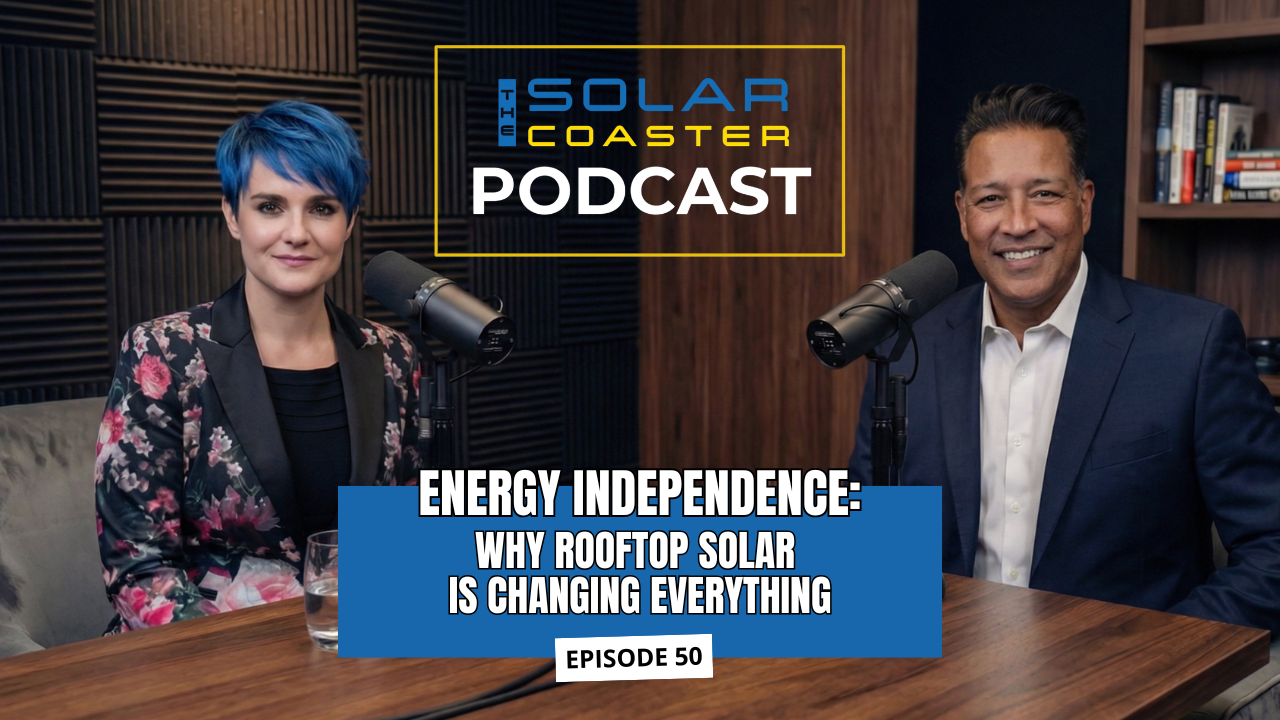
Solar energy and battery storage are transforming how electricity is generated, stored, and managed. But behind the physical infrastructure is an increasingly sophisticated digital ecosystem powered by software, artificial intelligence, communications technology, and automated controls. In this discussion, Anna Covert and Alex Herrera explore why intellectual property is becoming an important issue for the future of solar and the smart grid.
Anna Covert: Think about the electric grid for a moment. For nearly a century, it was arguably one of the most stable, slow-moving pieces of infrastructure on the planet. It was all about physical hardware—poles, wires, massive coal plants, and simple analog meters. But today, that picture is unrecognizable. The grid has transformed into a highly connected, digital ecosystem, driven by solar power, battery storage, and smart management systems. And with this massive shift, a hidden battleground has emerged, one fought not with steel and concrete, but with intellectual property. Why is patent litigation suddenly becoming a major headache for the clean energy sector?
Alex Herrera: It comes down to complexity. In the old days, power flowed in one direction: from a central power plant down to your home. Today, with rooftop solar, utility-scale solar farms, and battery storage systems, power flows in every direction. Managing that requires incredibly sophisticated software, edge controllers, and communication networks. Because this technology is so new and valuable, companies have spent the last two decades quietly filing patents on how these systems talk to each other and manage electricity. Now, we are entering a phase where those patents are maturing, and it is creating a very crowded, high-stakes legal environment for utilities and developers alike.
Anna Covert: So this isn't just a future risk; it is actively happening right now. It sounds like we are seeing the convergence of two distinct trends. You have the older, foundational smart grid technologies, and then you have this new wave of artificial intelligence and machine learning. How do these two waves interact?
Alex Herrera: That is exactly the right way to look at it. The first wave started in the early 2000s and peaked around the mid-2010s. This wave was all about the physical and digital foundation of the smart grid—things like advanced metering infrastructure, remote meter reading, and basic communication protocols. A lot of those patents were granted ten to fifteen years ago. In the patent world, that mid-life period is when things get interesting. The technology has matured, the market has adopted it, and patent holders realize this is the prime window to monetize their intellectual property through licensing or enforcement before the patents expire.
Anna Covert: It is like building a tollbooth on a highway after everyone has already started using the road. If you try to collect tolls before the road is paved, no one cares. But once it is the main highway for the clean energy transition, suddenly those patents are incredibly valuable.
Alex Herrera: Exactly. And just as that first wave is reaching its peak commercial value, we are seeing a second wave crash right on top of it. This second wave is driven by artificial intelligence and machine learning. Instead of just collecting data from a smart meter, companies are now using AI to predict weather patterns, forecast solar generation, optimize battery discharge rates, and manage local grid stability in real time. These AI-driven patents are being layered directly onto the older smart grid infrastructure.
Anna Covert: Which means even if a developer manages to navigate the legacy patents, they might still run straight into a wall of newer, AI-related patents. Let's break down what this actually looks like in practice. If you are a utility-scale solar developer or a company setting up a virtual power plant, where do the actual risks lie?
Alex Herrera: The risk lies in the overlap between everyday operations and patented methods. Take dynamic rate structures, for example. To make dynamic pricing work, you need real-time data on energy production and consumption. If a utility deploys a new platform to analyze this data and adjust prices, they might be using algorithmic methods that are already patented by a software vendor or a competitor. The same goes for virtual power plants, where you coordinate hundreds of individual home batteries to act as a single power source. The control strategies, the communication loop, the forecasting models—almost every step of that process is a candidate for patent protection.
Anna Covert: It sounds like a minefield. If you are a developer buying equipment and software from third-party vendors, you might assume that the vendor has cleared all the rights. But that is not always the case, is it?
Alex Herrera: Not at all. Often, vendors sell a product, but the way the utility integrates and uses that product within their specific grid architecture is what actually triggers the patent infringement. Or, the vendor itself might get sued, which can disrupt the utility's operations or lead to costly supply chain delays. This is why we are seeing a shift in how these projects are negotiated. It is no longer just about the price per megawatt or the efficiency of an inverter; it is about who bears the intellectual property risk if a lawsuit arises.
Anna Covert: So, how do companies protect themselves? If you are a utility or a clean energy developer, you can't just stop deploying solar and batteries because of patent risks. The transition has to move forward. What are the practical steps to mitigate this?
Alex Herrera: The first step is proactive due diligence, specifically what lawyers call a "freedom-to-operate" analysis. Before rolling out a major new technology platform or grid initiative, companies need to work with legal teams to map out the existing patent landscape. You want to know who holds the key patents in the space you are entering. If you find a potential conflict early, you can design around it, choose a different vendor, or negotiate a license before you have invested millions of dollars in deployment.
Anna Covert: That makes sense. It is much cheaper to adjust your software architecture during the design phase than it is to rewrite it after a cease-and-desist letter arrives. What about the contracts themselves? How do you handle vendor relationships in this environment?
Alex Herrera: Strong indemnity provisions are crucial. When utilities purchase smart grid software or advanced hardware, they need to ensure the contract explicitly states that the vendor will defend them and cover any damages if the technology is found to infringe on someone else's patent. But even then, indemnity is only as good as the financial health of the vendor. If a small startup sells you a revolutionary AI forecasting tool and then gets sued, they might not have the resources to cover your legal defense.
Anna Covert: Which brings up an interesting strategic point. If you are a company developing these advanced AI tools for the grid, you shouldn't just be playing defense. Having your own patent portfolio can actually be a powerful shield, right?
Alex Herrera: Absolutely. In a crowded patent landscape, having your own intellectual property is a form of currency. If a competitor accuses you of infringing on their patent, but you hold patents that they might be infringing on, it often leads to a cross-licensing agreement rather than a protracted, expensive courtroom battle. It gives you leverage. Furthermore, protecting your unique algorithms and system designs creates tangible business value, making you a more attractive partner or acquisition target.
Anna Covert: It is fascinating how the energy sector is starting to resemble the smartphone wars of the early 2010s, where tech giants sued each other constantly over software features. We are seeing those same dynamics play out in the power grid.
Alex Herrera: The comparison is spot-on. The grid is becoming a giant computer, and just like the telecom industry, the winners won't just be the ones with the best hardware. They will be the ones who navigate the intellectual property landscape most effectively.
Anna Covert: Looking ahead, this seems like a trend that will only accelerate. As the grid becomes more decentralized and more reliant on real-time data, the role of AI will transition from a luxury to an absolute necessity.
Alex Herrera: Definitely. We cannot run a high-penetration solar grid without machine learning. Human operators simply cannot process the data fast enough to balance supply and demand when cloud cover changes or millions of electric vehicles plug in simultaneously. Because AI is essential, the patents covering these AI applications will become the most valuable assets in the energy sector.
Anna Covert: It highlights the need for a cultural shift in the clean energy industry. Engineering teams and legal teams need to work hand-in-hand from day one. Intellectual property can no longer be treated as an afterthought or a line item handled at the very end of a project.
Alex Herrera: Exactly. It has to be integrated into the core engineering and business strategy. If you are designing a new control algorithm for a battery storage facility, the patent search should be happening alongside the initial coding, not years later when the system is already live on the grid.
Anna Covert: It is clear that the transition to a clean energy future is about more than just solar panels and wind turbines. It is about the digital brain that runs it all, and the quiet battle for who owns the rights to that brain. For developers, utilities, and technology providers, understanding this evolving patent landscape isn't just about avoiding risk—it is about securing their place in the future of energy.