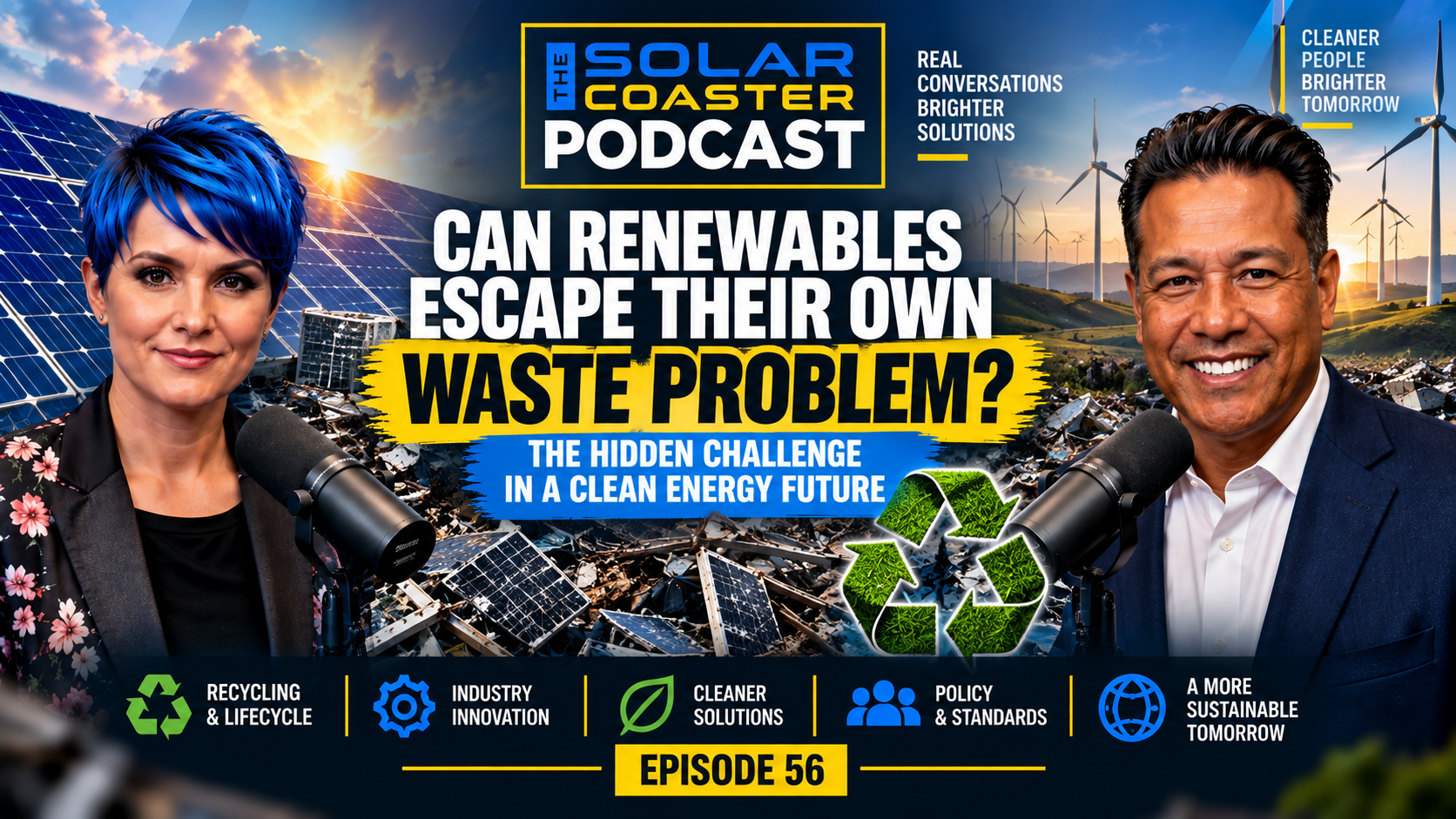
In a recent episode of The Solar Coaster Podcast, Anna Covert and Alex Herrera examine an industry report describing more than 90% solar tracker penetration in North American utility-scale projects and more than $1.6 billion in acquisitions by leading tracker suppliers since 2024.
The discussion explores why manufacturers are expanding into adjacent clean energy businesses and what that trend could mean for project developers, procurement teams and the broader solar industry.
Why Solar Trackers Became Standard in Utility-Scale Solar
Solar tracking systems adjust the orientation of photovoltaic modules to follow the sun throughout the day.
For many utility-scale installations, tracking technology can increase energy production compared with fixed-tilt systems, depending on site conditions and engineering design.
As the technology gained acceptance, trackers became widely adopted across North American utility-scale projects.
According to the report discussed in the podcast, market penetration now exceeds 90%.
That level of adoption reflects the technology’s established role in utility-scale project design, but it also changes the growth opportunities available to manufacturers.
Why Manufacturers Are Looking Beyond Trackers
When a technology is already widely adopted, suppliers may have fewer opportunities to grow by converting customers from alternative products.
Manufacturers can continue competing for new projects, but expanding market share within an established category becomes increasingly challenging.
The industry report discussed by Anna and Alex describes more than $1.6 billion in acquisition investment since 2024, focused on solar mounting and adjacent clean energy businesses.
These investments suggest that leading suppliers are seeking additional growth opportunities through broader product and service offerings.
The report also indicates that much of the acquisition capital has circulated within the United States, highlighting the importance of the domestic market to the activity described.
The Potential Benefits of Broader Supplier Platforms
For utility-scale solar developers, a supplier that provides multiple related products or services could offer certain operational advantages.
Depending on the capabilities involved, broader offerings may help simplify procurement, improve coordination or reduce the number of separate vendor relationships required for a project.
However, those advantages are not automatic.
Successful integration requires consistent product quality, clear warranties, dependable customer support and effective coordination across business units.
Developers should evaluate whether a broader supplier platform offers measurable project benefits rather than relying solely on the convenience of purchasing multiple products from one company.
Acquisitions Introduce New Operational Challenges
Acquiring a business can expand a manufacturer’s capabilities, but it also introduces responsibilities.
Different product categories may involve distinct engineering standards, supply chains, manufacturing processes and customer expectations.
For utility-scale projects, reliability and schedule coordination are particularly important. Delays or equipment issues can have significant financial and operational consequences.
As manufacturers expand, maintaining consistency across their combined offerings becomes an important consideration for customers.
The available report identifies acquisition activity but does not provide sufficient information to evaluate the performance of individual transactions.
How Consolidation Could Affect Solar Procurement
As larger suppliers expand, procurement teams may encounter more comprehensive proposals and bundled offerings.
Those changes could influence how developers compare equipment, services and long-term supplier relationships.
Key considerations include:
- Product reliability: Does the supplier maintain consistent engineering and quality standards?
- Project coordination: Do combined offerings improve scheduling and delivery?
- Warranty clarity: Are responsibilities clearly defined across products and services?
- Commercial value: Does the bundled proposal provide measurable benefits?
- Supplier flexibility: Can developers still evaluate specialized alternatives?
- Long-term support: Does the expanded organization have the resources and processes needed to support installed projects?
These questions help developers determine whether supplier consolidation creates practical value for their projects.
What This Means for Smaller and Specialized Suppliers
Consolidation may also change how smaller manufacturers compete.
Specialized suppliers may emphasize technical expertise, product differentiation, customer service or specific market segments.
Some businesses may explore partnerships or acquisitions as larger companies expand their offerings.
However, the future competitive structure remains uncertain. The report discussed in the podcast does not identify specific acquisition targets or predict how individual companies will perform.
A More Mature Utility-Scale Solar Market
The reported acquisition activity illustrates a broader characteristic of maturing industries.
Early growth often comes from proving that a technology works and encouraging adoption. Later growth may depend more heavily on operational efficiency, new capabilities, geographic expansion and corporate strategy.
Solar tracker manufacturers appear to be navigating that transition.
For developers, understanding changes in the supplier landscape can help inform procurement strategies and long-term project planning.
Building Successful Utility-Scale Solar Projects
Utility-scale solar development involves far more than selecting individual components.
Project economics, site conditions, engineering, equipment availability, utility requirements and supplier coordination all influence development decisions.
As manufacturers expand into broader clean energy offerings, developers will need to continue evaluating how those changes affect project execution and long-term value.
Learn more about Sun Energy Today’s utility-scale solar solutions and explore our solar projects.
Explore Solar Opportunities With Sun Energy Today
Sun Energy Today supports commercial and utility-scale solar development.
Explore our commercial solar solutions, learn about utility-scale solar opportunities or contact our team to discuss your energy goals.
Watch The Solar Coaster Podcast
Watch Anna Covert and Alex Herrera discuss the solar tracker acquisition wave and its implications for the industry on The Solar Coaster Podcast.
Discover additional episodes and learn about The Solar Coaster book.
Sponsored by Sun Energy Today
This episode is sponsored by Sun Energy Today, a commercial solar and storage developer focused on MW-scale infrastructure and long-term energy resilience.
🌐 https://sunenergytoday.com/
💼 https://www.linkedin.com/in/atzael-herrera/
Listen to the Full Episode
🎧 Spotify: https://open.spotify.com/show/28LLOtNEQj8ZoCZJqVOa7o
🎧 Apple Podcasts: https://podcasts.apple.com/us/podcast/the-solar-coaster-podcast/id1832579656
🎧 Amazon Music: https://music.amazon.com/podcasts/342b84c9-ccb9-4cdb-99cc-ed6254503bfa/the-solar-coaster-podcast
🎧 iHeart Radio: https://iheart.com/podcast/292376116/
📺 YouTube: https://www.youtube.com/@solarcoasterbook
⚠️ AI Transparency Notice: This episode uses AI-generated voice technology based on the real voices of Anna Covert and Alex Herrera. Both individuals have provided full knowledge and consent for their voices and likenesses to be used in this AI-produced episode. The insights shared reflect their real-world experience and professional viewpoints. This episode is clearly labeled as AI-assisted and is not intended to mislead viewers regarding identity or authorship.
THE SOLAR COASTER PODCAST
Solar Trackers Hit 90% Market Penetration. Now What?
$1.6 Billion in Acquisitions
Featuring Anna Covert and Alex Herrera
Solar Coaster | Sponsored by Sun Energy Today
Editor's note: This dialogue was reconstructed from episode material and has not been verified against the original recording.
Episode Transcript
Anna Covert: Today we are looking at a corner of the solar industry that can sound very technical, but actually tells a much bigger story about where clean energy companies think growth will come from next. The focus is solar trackers in North America. These are the systems that help utility-scale solar panels follow the sun, and in that market they have become almost standard. The key point is that tracker companies have been highly successful, so successful that the domestic market is now close to saturated. Since 2024, solar tracker companies in North America have invested more than 1.6 billion dollars in acquisitions, and many of those deals are about moving beyond solar mounting and into adjacent parts of the clean energy value chain.
Alex Herrera: That is the interesting tension. On one hand, having more than 90% market penetration in utility-scale projects is an extraordinary position for any technology. It means trackers are not a niche option anymore. They are the default choice for most large solar projects in the region. On the other hand, that level of adoption also limits the obvious path to growth. If nearly everyone who can use the product already does use it, selling more trackers into the same type of project becomes harder. So the question changes. It is no longer just, how do you sell more tracking systems? It becomes, how do you turn a dominant position in one part of the project into a broader role across clean energy infrastructure?
Anna Covert: Exactly. The article frames tracker companies as, in a sense, victims of their own success. That phrase matters because the problem is not weakness. It is maturity. A market that has reached more than 90% penetration has already persuaded most of its target customers. Developers and asset owners have absorbed the technology into normal practice. That is very different from an early-stage market where the main task is education or proving bankability. Here, the commercial challenge is what happens after the technology becomes normal. And the answer, at least according to the acquisition activity described, is that companies are following the money into nearby segments where their customer relationships, engineering experience, and project knowledge may still give them leverage.
Alex Herrera: The figure is striking: more than 1.6 billion dollars invested in corporate acquisitions since 2024 by solar tracker companies in North America. That is not a small adjustment around the edges. It suggests a deliberate strategic push. The article also notes that the majority of this capital has circulated within the United States, and that the activity has been led by North America's largest tracker suppliers. So this is not presented as a broad scatter of small experimental deals. It is the leading companies using acquisitions as a tool to reposition themselves. They are trying to expand beyond solar mounting and into adjacent segments of the clean energy value chain.
Anna Covert: And that phrase, adjacent segments of the clean energy value chain, is doing a lot of work. It does not mean these companies are suddenly abandoning trackers. It means they are trying to add capabilities around the core business. The article does not give us the full list of acquired businesses in the accessible material, so we should be careful not to fill in details that are not stated. But the direction is clear. These companies have a strong place in utility-scale solar. They are now looking around that project ecosystem and asking where else they can capture value. Lorenz Golser of S&P Global interprets this as part of a wider strategy to build a one-stop shop for clean energy.
Alex Herrera: The one-stop shop idea is important because it changes the relationship between supplier and customer. A tracker supplier traditionally provides a crucial physical system, but still only one part of a much larger project. If that supplier can offer more products or services across the clean energy value chain, it may become more deeply embedded in the project. That could make procurement simpler for customers, at least in theory. It could also give